
For decades, the Holland Grill has marketed itself with a straightforward promise: “If you’re lookin’, you ain’t cookin’.”
Known for their unique indirect heating system and lack of flare-ups, these grills have built a cult following among barbecue enthusiasts who value consistency over high-maintenance searing.
However, even the most reliable machinery eventually runs into hiccups.
There is nothing quite as frustrating as prepping a rack of ribs or a set of steaks, only to find your grill won’t light, won’t heat up, or is making a sound like a jet engine preparing for takeoff.
Because Holland Grills operate differently than standard gas grills using a cast-iron burner, a heat deflector, and a drip pan to separate food from flame troubleshooting them requires specific knowledge. A fix for a standard Weber might not apply here.
If your trusty outdoor cooker is acting up, don’t rush to drag it to the curb. Most issues stem from simple maintenance lapses or easily replaceable parts.
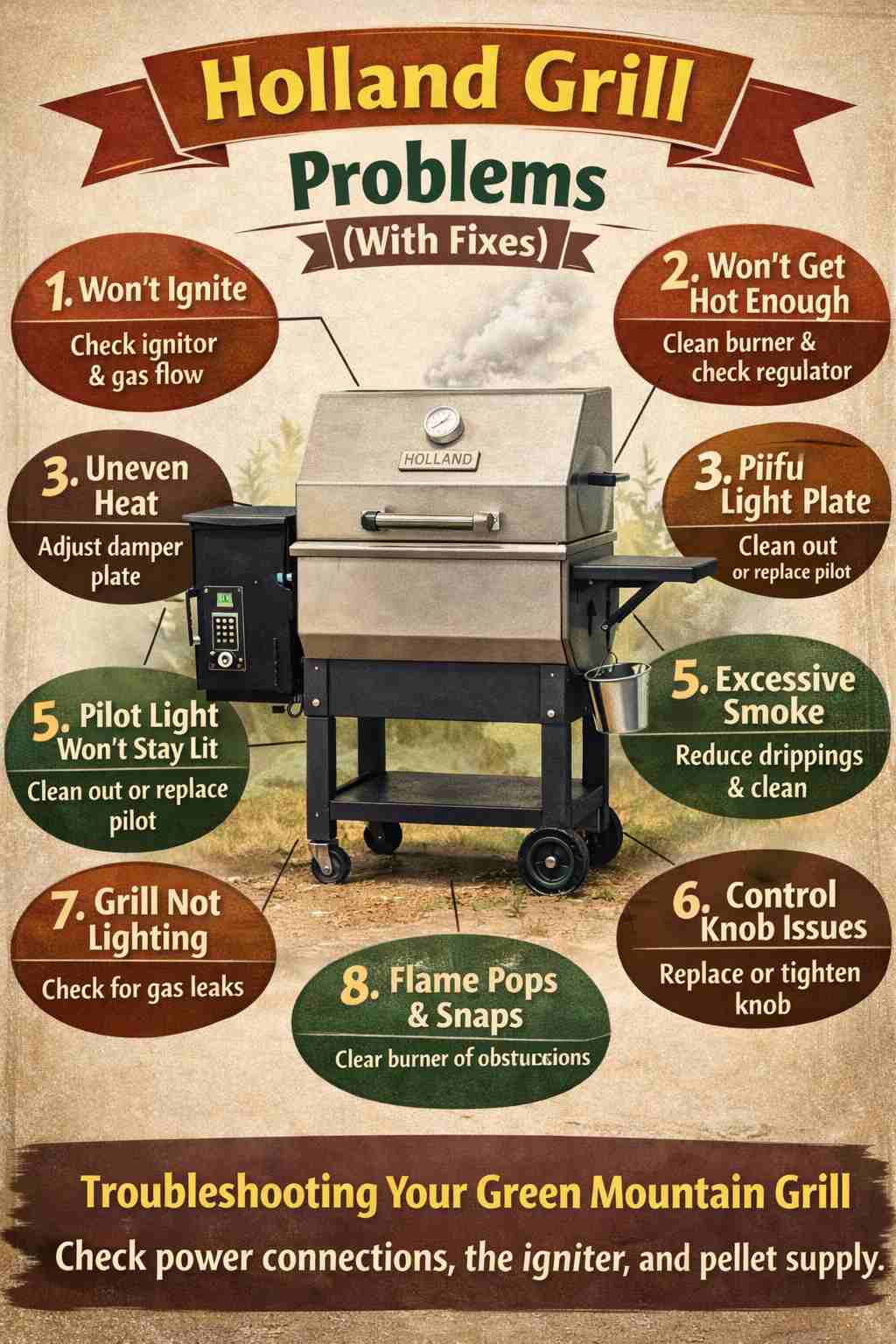
In this comprehensive guide, we will break down the 14 most common Holland Grill problems and provide detailed, step-by-step fixes to get you back to grilling in no time.
1. The Grill Won’t Light (No Spark)
This is perhaps the most common annoyance. You turn the gas on, twist the igniter, and… silence. If there is no “click” or spark, the gas has nothing to ignite.
Possible Causes
- Dead battery (for electronic igniters).
- Corroded battery contacts.
- Loose or disconnected wires.
- Faulty electrode or spark generator.
The Fix
First, determine if you have a rotary sparker (a knob you turn hard) or an electronic sparker (a button you push).
- Check the Battery: If you have a push-button igniter, unscrew the cap and replace the AA or AAA battery. Ensure the positive end faces the correct direction.
- Clean Contacts: If the battery leaked, use a small piece of sandpaper or a pencil eraser to clean the corrosion off the metal contacts inside the battery compartment.
- Inspect Wiring: Look behind the control panel. Ensure the black wire connecting the igniter to the electrode (near the burner) is firmly attached. If the wire is frayed or chewed by rodents, wrap it in electrical tape or replace it.
- Check the Electrode Gap: The metal tip near the burner should be about 3/16 of an inch away from the burner port. If it’s too far, gently bend it closer.
10 Common Traeger Pro 34 Temperature Problems (With Fixes)
2. The Grill Won’t Light (Has Spark but No Flame)
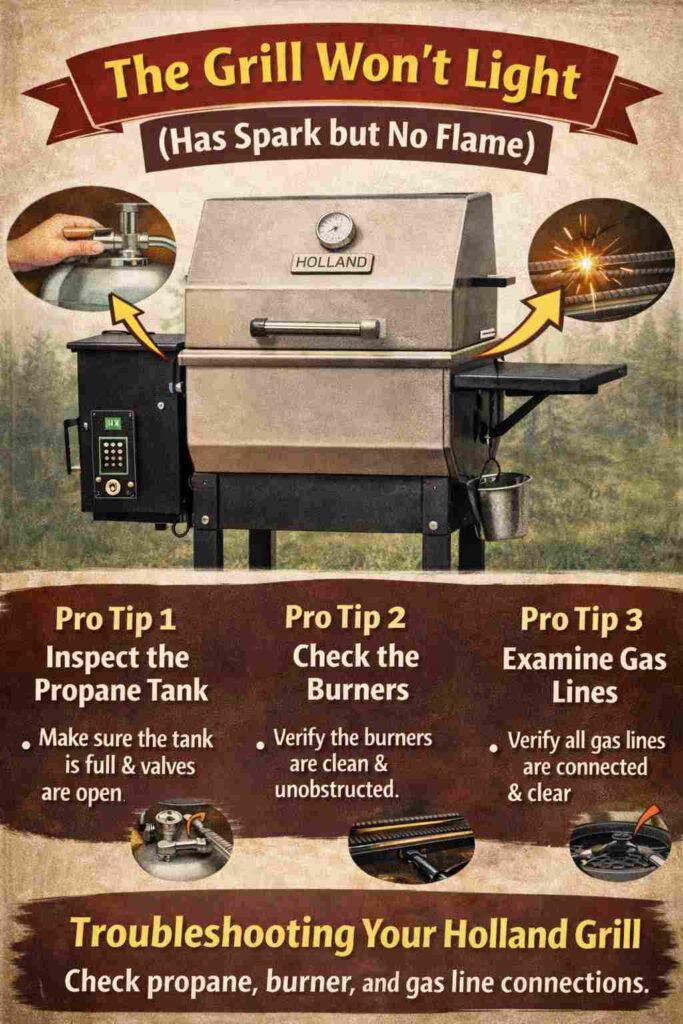
You hear the clicking sound of the spark, and you smell gas, but the burner refuses to catch fire.
Possible Causes
- Clogged burner ports.
- Misaligned electrode.
- Wind blowing the gas away before ignition.
The Fix
- Manual Light Test: Try lighting the grill with a long match or a grill lighter through the lighting hole. If it lights manually, your gas flow is fine, and the issue is the spark location.
- Clean the Burner: Over time, grease and food debris can clog the tiny holes in the cast iron burner. Remove the burner and use a stiff wire brush or a drill bit to clear the ports near the ignition source.
- Adjust Electrode Position: As mentioned above, the spark must jump to a spot where gas is present. Ensure the electrode isn’t sparking against the grill body instead of the burner.
3. Low Heat (Grill Won’t Go Above 300°F)
Holland Grills are designed to cook at a steady medium-high heat (around 400°F). If your temperature gauge is stuck at 250°F or 300°F, your food will steam rather than roast.
Possible Causes
- Tripped safety flow limiting device (regulator).
- Clogged venturi tube (spider webs).
- Empty propane tank.
The Fix
Reset the Regulator: This is the most likely culprit. Modern propane regulators have a safety feature that restricts gas flow if it detects a leak. Opening the tank valve too quickly can trip this sensor.
- Turn off the burner control knob and the propane tank valve.
- Disconnect the hose from the tank.
- Wait for 30 seconds to let the pressure equalize.
- Reconnect the hose.
- Slowly open the propane tank valve.
- Light the grill.
Clean the Venturi Tube: Spiders love the smell of propane. They often spin webs inside the tube that connects the valve to the burner, restricting flow. Remove the burner assembly and run a flexible venturi brush or a pipe cleaner through the tube to clear obstructions.
10 Common Reasons Traeger Grill Not Igniting (With Fixes)
4. Yellow or Orange Flame
A healthy propane flame should be mostly blue with a tiny yellow tip. If your flame is entirely yellow or orange, it indicates incomplete combustion, which produces soot and low heat.
Possible Causes
- Lack of oxygen (air shutter closed).
- Debris inside the burner.
- Poor quality gas.
The Fix
- Adjust the Air Shutter: Locate the air shutter at the end of the burner (where it connects to the valve). Loosen the set screw.
- Tune the Flame: Light the grill. Carefully rotate the shutter to open the air intake until the flame turns blue. If the flame lifts off the burner, you have too much air; close it slightly.
- Tighten the Screw: Once the flame is blue and steady, tighten the screw to lock the shutter in place.
5. Excessive Flare-Ups
The main selling point of a Holland Grill is the absence of flare-ups. If you are seeing flames shooting up around your food, something is fundamentally wrong with the setup.
Possible Causes
- Dirty drip pan.
- Blocked drain pipe.
- Cooking with the lid open.
The Fix
- Close the Lid: Holland Grills are designed to cook with the lid closed. Opening it creates a chimney effect that can pull flames upward.
- Unclog the Drain: There is a drain pipe that leads grease from the drip pan to the bucket. If this is clogged, hot grease pools in the pan and catches fire. Use a wire hanger to clear the drain pipe.
- Scrape the Pan: If heavy carbon buildup or grease has accumulated on the drip pan, scrape it clean with a putty knife.
6. Uneven Heating
If your steaks are burning on the right side but raw on the left, your heat distribution is compromised.
Possible Causes
- The grill is not level.
- Burner is corroded or clogged on one side.
- Heat deflector plate is damaged.
The Fix
- Level the Grill: The drip pan relies on gravity to move grease, and the heat rises naturally. If the grill is tilting, heat will pool in the highest corner. Use a carpenter’s level and adjust the casters or legs.
- Inspect the Deflector: Beneath the cooking grid is a heat deflector plate. If it has rusted through or has holes, direct heat will hit the food. Replace the deflector plate if it is compromised.
7. A “Whooshing” or Roaring Sound
If your grill sounds like a jet engine or is making a loud “whooshing” noise, you likely have a flashback fire. This means the gas is burning inside the venturi tube rather than at the burner ports.
Possible Causes
- Obstruction in the venturi tube.
- Wind blowing into the burner.
The Fix
Immediate Action: Turn off the gas immediately. This condition can melt the control panel and damage the valve.
- Allow to Cool: Let the grill cool down completely.
- Clean the Tube: As described in the “Low Heat” section, remove the burner and clean the venturi tube thoroughly. A spider web or insect nest is almost always the cause.
8. Temperature Gauge Is Inaccurate
You are following a recipe perfectly, but the food is either undercooked or burnt. The built-in thermometer might be lying to you.
Possible Causes
- Moisture inside the lens.
- Carbon buildup on the probe.
- Calibration loss due to age.
The Fix
- Clean the Probe: Open the lid and look at the metal probe sticking into the hood. Scrub off any black carbon buildup with steel wool.
- Boiling Water Test: Remove the thermometer from the grill. Place the probe tip into a pot of boiling water. It should read 212°F (100°C).
- Adjust or Replace: Some thermometers have a calibration nut on the back that you can turn to adjust the needle. If yours doesn’t, or if it is off by more than 20 degrees, buy a replacement gauge.
9. Gas Smell (Leakage)
Smelling gas while cooking is normal; smelling strong gas near the tank or hoses is dangerous.
Possible Causes
- Loose connection at the tank.
- Cracked or dry-rotted hose.
- Faulty regulator.
The Fix
The Soap Test: Never use a flame to check for leaks.
- Mix dish soap and water in a spray bottle or bowl.
- Turn the gas on (but do not light the grill).
- Spray or brush the soapy water onto the hose, the regulator connection, and the valve connection.
- Look for Bubbles: If the solution bubbles up, gas is escaping. Tighten the connection. If it still bubbles, replace the hose or regulator immediately.
10. Regulator Freezing Up
If you see frost on your regulator or propane tank even on a mild day, it indicates a rapid expansion of gas.
Possible Causes
- High humidity combined with high gas flow.
- Liquid propane entering the regulator (tank not upright).
The Fix
- Check Tank Orientation: Ensure the propane tank is sitting perfectly upright. If it is tilted, liquid propane can enter the hose, which freezes as it expands into gas.
- Slow Down: If you are running the grill on high for extended periods in humid weather, turn it off for 10 minutes to let the regulator thaw, then restart.
11. Excessive Smoke
While some smoke is desirable for flavor, billowing thick white or black smoke is not.
Possible Causes
- Grease buildup in the drip pan.
- Burning leftover food on the grate.
- Poor quality marinade (high sugar content burning).
The Fix
- The “Steam Clean”: After cooking, while the grill is still hot, close the lid and let it run on high for 15 minutes to burn off residue. Then, turn it off and scrub the grates.
- Clean the Drip Pan: We cannot stress this enough—a clean drip pan is essential for the Holland system. Remove the pan and wash it with degreaser and hot water.
12. Rusting Exterior or Interior
Holland Grills are durable, but they are made of metal. Exposure to the elements will eventually cause rust.
Possible Causes
- Leaving the grill uncovered.
- Scratching the powder coat.
- Salt air (coastal environments).
The Fix
- Surface Rust: Sand the rusted area with fine-grit sandpaper until you reach bare metal. Wipe it clean with acetone or alcohol.
- Repaint: Use high-heat barbecue paint (specifically rated for 1200°F or higher). Apply several thin coats rather than one thick coat.
- Season the Inside: Just like a cast-iron skillet, you can season the inside of the grill (drip pan and grates) by coating them with cooking oil and heating the grill. This creates a protective barrier.
13. Valve Knob is Hard to Turn
The control knob feels stiff, gritty, or won’t turn at all.
Possible Causes
- Dried grease inside the valve stem.
- Corrosion.
- Bent valve stem.
The Fix
- Lubricate: Pull the black plastic knob off the valve stem. Spray a small amount of WD-40 or silicone lubricant down the shaft of the stem. Work the knob back and forth.
- Replacement: If lubrication fails, the internal tumblers of the valve are likely damaged. You will need to order a replacement valve assembly from a Holland Grill parts dealer.
14. Burner Deterioration
The heart of the grill is the cast iron burner. Eventually, it may crack, split, or bow.
Possible Causes
- Thermal shock (rapid heating and cooling).
- Moisture leading to rust.
- Age (normal wear and tear).
The Fix
Inspect the burner annually. If you see large cracks, holes (other than the gas ports), or if the metal is flaking off in large chunks, it’s time to replace it. A compromised burner is a safety hazard. Buying a replacement cast iron burner is significantly cheaper than buying a new grill and installs in about 5 minutes with a single cotter pin.
Keeping Your Holland Grill Alive for Years to Come
The Holland Grill is often called the “set it and forget it” machine of the grilling world. Its simplicity is its strength; with fewer moving parts than complex infrared or multi-burner grills, there is less that can go wrong. However, treating it with a little respect goes a long way.
The vast majority of the problems listed above—specifically low heat, uneven cooking, and flare-ups—can be prevented with a simple cleaning routine. Keeping the venturi tubes clear of spider webs and ensuring the drip pan is free of heavy sludge will solve 90% of your headaches.
If you have run through these 14 fixes and your grill is still struggling, it might be time to consult the warranty. Holland Grills traditionally come with excellent warranties on their burners and cooking grids. Don’t let a small mechanical issue stand between you and the perfect backyard barbecue. Grab your screwdriver, reset that regulator, and get back to cooking.
Frequently Asked Questions (FAQs)
How often should I clean my Holland Grill burner?
You should inspect and clean the burner at least once a year, preferably at the start of the grilling season. However, if you store the grill outdoors without a cover, you should check the venturi tube for spider webs anytime the grill has sat unused for more than a month.
Can I use lava rocks or ceramic briquettes in a Holland Grill?
No. Holland Grills are strictly designed to use a metal heat deflector and a drip pan. Adding lava rocks or briquettes will disrupt the airflow, cause massive flare-ups, and likely void your warranty. The system relies on radiant heat from the drip pan, not direct heat from rocks.
Why does my Holland Grill smoke so much when I first light it?
This is usually due to leftover grease in the drip pan or on the cooking grid from the previous cookout. As the grill heats up, this old grease burns off. To prevent this, scrape your grid and ensure the drip pan drains correctly after every use.