
There are few things more frustrating than prepping a rack of ribs, marinating a brisket for 24 hours, or getting ready to sear the perfect steak, only to find that your grill won’t cooperate.
Louisiana Grills are known for their heavy-duty construction and premium smoking capabilities, but like any machine with moving parts and electronic components, they aren’t immune to occasional hiccups.
Owning a pellet grill requires a different set of troubleshooting skills than owning a standard gas or charcoal grill.
You are dealing with augers, induction fans, digital control boards, and temperature probes. When one link in that chain fails, the whole cooking process can grind to a halt.
The good news is that most issues are not fatal to your grill. With a screwdriver, a little bit of patience, and the right knowledge, you can solve the majority of these malfunctions right in your backyard.
This guide covers the 10 most common Louisiana Grill problems owners face and provides detailed, step-by-step solutions to get you back to smoking in no time.
1. The Grill Won’t Turn On
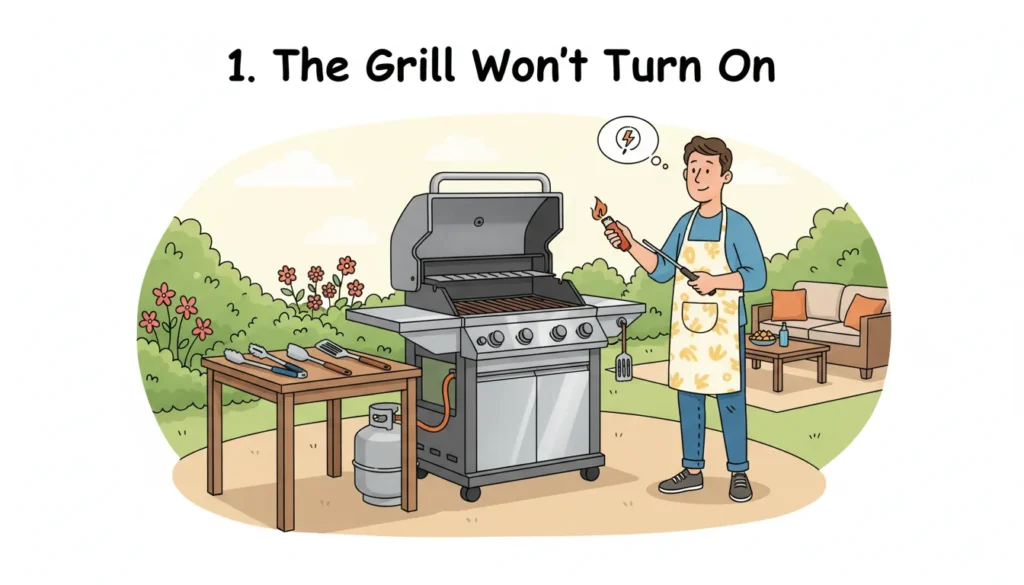
It is the most basic, yet panic-inducing problem: you press the power button, and the screen remains dark. Before you assume the control board is fried, you need to check the power supply chain.
Why it happens:
Usually, this isn’t a sign of a broken grill, but rather a tripped safety mechanism. It could be a tripped GFI outlet, a loose connection, or most commonly, a blown fuse on the control board itself.
How to fix it:
- Check the outlet: Plug a lamp or phone charger into the outlet to ensure it has power. If your grill is plugged into a GFI outlet (common in outdoor spaces), ensure the breaker hasn’t tripped due to moisture.
- Inspect the power cord: Look for any damage, fraying, or chew marks from pets or pests.
- Check the fuse: This is the most likely culprit. Unplug the grill. Unscrew the faceplate of the digital control board and carefully pull it out. Look for a small glass fuse (usually 5 amp). If the wire inside the glass is broken or the glass is black, the fuse is blown. Replace it with a standard 5-amp fast-blow fuse found at any hardware store.
10 Common Traeger Pro 34 Temperature Problems (With Fixes)
2. The Auger Is Jammed
If you can hear the fan running but the grill isn’t heating up, or if you hear a groaning, straining sound coming from the hopper, you likely have an auger jam.
Why it happens:
Moisture is the enemy of wood pellets. When pellets get wet, they dissolve into wet sawdust. When that sawdust dries, it turns into a substance nearly as hard as concrete. If this happens inside the auger tube, the motor cannot push the fuel through.
How to fix it:
- Empty the hopper: Remove all loose pellets from the hopper.
- Access the motor: You will need to remove the panel housing the auger motor. Remove the pin or screw connecting the motor to the auger shaft.
- Clear the blockage: If the jam is minor, you might be able to break it up with a long screwdriver through the feed chute. For severe jams, you may need to remove the entire auger assembly and use a pipe wrench or vice grips to physically twist the auger free.
- Prevent it: Never leave pellets in the hopper if you aren’t using the grill for a few weeks, especially in humid climates.
10 Common Reasons Traeger Grill Not Igniting (With Fixes)
3. Wild Temperature Fluctuations
A pellet grill is essentially an outdoor oven designed to hold a steady temperature. If your set point is 225°F but your grill is swinging between 180°F and 280°F, your food will suffer.
Why it happens:
This is often caused by a dirty Real-Time Data (RTD) temperature probe, poor quality pellets, or improper P-settings (Pause settings) on older controllers. Wind is another major factor; if cold wind blows directly into the grease drain or rear vents, the grill will overcompensate with fuel.
How to fix it:
- Clean the RTD Probe: Locate the vertical metal rod inside the cook chamber. Over time, it gets coated in smoke and grease, which insulates it from the true heat. Wipe it down gently with a damp cloth and soapy water.
- Check your fuel: If your pellets are old or crumbling, they won’t burn consistently. Swap them for a fresh bag of premium hardwood pellets.
- Adjust the P-Setting: If you have a legacy controller, look at the “P-Set” button. In colder weather, you generally want a lower P-setting (to feed pellets more often). In hot weather, a higher P-setting prevents overheating.
- Shield the grill: Move the grill to a sheltered area to prevent wind from disrupting the airflow.
4. Failure to Ignite (No Fire)
You turn the grill on, the fan blows, pellets feed into the pot, but 10 minutes later, there is still no smoke and the temperature reads ambient.
Why it happens:
The igniter rod (hot rod) is responsible for lighting the initial fire. These elements have a lifespan and eventually burn out. Alternatively, the firepot might be overflowing with ash, preventing the rod from contacting the new pellets.
How to fix it:
- Check the firepot: Before every cook, ensure the firepot is clean. If it is buried in ash, the rod can’t light the wood.
- Test the rod: Turn the grill on and hold your hand over the firepot (do not touch it). You should feel significant heat radiating within a few minutes. If it stays cold, the rod is dead.
- Manual lighting: You can still use your grill while waiting for a replacement part. Put a small handful of pellets in the pot, add a gel fire starter or use a torch to light them, then turn the grill on.
- Replace the rod: This involves removing the hopper assembly and threading a new wire through to the control board. It is a standard maintenance task for pellet grill owners.
5. Excessive or “Dirty” Smoke
While we want smoke for flavor, we want “thin blue smoke.” If your Louisiana Grill is billowing thick, white, bitter-smelling smoke, something is wrong.
Why it happens:
This is incomplete combustion. It happens when the fire is being smothered by too many pellets or there isn’t enough airflow.
How to fix it:
- Check the Induction Fan: Ensure the fan is spinning freely. If the fan is dying, it won’t provide enough oxygen for a clean burn.
- Clean the burn grate: Ensure the holes in the firepot are not clogged. Air needs to come up through those holes to feed the fire.
- Don’t overfill on startup: If you manually added too many pellets to the pot before starting, they will smolder rather than burn cleanly.
6. The “Er1” Error Code
Louisiana Grill controllers are programmed to display error codes when safety parameters are breached. “Er1” is one of the most common codes you will see.
Why it happens:
Er1 indicates a temperature probe connection failure. The control board is not receiving a signal from the RTD probe inside the barrel.
How to fix it:
- Check connections: Unplug the grill and unscrew the control board. Follow the wires from the RTD probe to the board. Ensure the connection is tight. Unplug and replug the connector to scrape off any oxidation.
- Inspect wires: Look for kinks or breaks in the probe wire. Sometimes, the wire gets pinched during assembly or movement.
- Replace the probe: If the connection is solid but the error persists, the probe itself is faulty and needs replacement.
7. The “ErH” (High Temp) Error Code
This code appears when the grill exceeds a safety limit, typically around 615°F or higher, causing the grill to shut down to prevent a fire.
Why it happens:
This is usually caused by a grease fire or an accumulation of too much fuel in the firepot which then ignites all at once.
How to fix it:
- Turn it off: Unplug the grill immediately and keep the lid closed to starve any fire of oxygen.
- Clean the grill: Once cool, deep clean the interior. Remove grease from the drain pan and the bottom of the barrel.
- Restart procedure: Ensure the firepot is empty before restarting. If there are unburnt pellets from a previous failed ignition, do not just restart the grill; clear them out first.
8. Pellets “Tunneling” in the Hopper
You are in the middle of a 12-hour brisket cook. You check the hopper and see it’s full, but the fire has gone out. Upon closer inspection, you see the auger intake is empty, but pellets are stuck to the sides of the hopper walls.
Why it happens:
This is called tunneling. The auger pulls pellets from the center bottom, but if the pellets are too long or the hopper slope isn’t steep enough, the remaining pellets won’t slide down to fill the void.
How to fix it:
- The manual stir: If you are doing a long cook, make it a habit to tap the side of the hopper or stir the pellets every few hours.
- Wax the hopper: Some owners apply a layer of car wax to the interior slope of the hopper (ensure it is dry first) to make the surface slicker, helping pellets slide down more easily.
- Sift your pellets: The “fines” (dust) at the bottom of a bag can create friction. Sifting your pellets before pouring them in can reduce bridging and tunneling.
9. The Induction Fan Isn’t Working
The fan is the lungs of the grill. Without it, the fire dies. If you don’t hear the hum of the fan when you turn the unit on, you have an airflow problem.
Why it happens:
Debris (like a zip tie or a dropped pellet) might be blocking the fan blades, or the motor bearing might have seized up.
How to fix it:
- Inspect visually: Lay on the ground and look up at the fan (usually under the hopper). Is there anything stuck in the blades?
- The “flick” test: With the grill unplugged, use a screwdriver to gently push the fan blades. They should spin freely with little resistance. If they are stiff or gritty, the motor needs replacing.
- Check wiring: Ensure the wire harness connecting the fan to the control board hasn’t vibrated loose.
10. Strange Noises (Squeaking or Grinding)
A pellet grill should make a low hum (fan) and an intermittent motorized sound (auger). High-pitched squeals or loud grinding noises are not normal.
Why it happens:
A squeak is usually the auger rubbing against the tube or a dry bearing. A rhythmic “thump” usually means the auger motor is straining.
How to fix it:
- Lubricate: Use a high-temperature food-safe lubricant on the auger bushings (where the auger meets the motor).
- Realign: Sometimes the auger motor screws come loose, causing the auger to sit at an angle. Tightening the mounting screws can align the shaft and stop the grinding.
- Check for foreign objects: Ensure a rock or piece of metal hasn’t accidentally fallen into the hopper and jammed against the auger.
Maintain Your Grill to Avoid Repairs
While troubleshooting is a useful skill, prevention is always better than a cure. The vast majority of these 10 common Louisiana Grill problems can be avoided with a simple maintenance routine.
Vacuum out the firepot after every 2-3 long cooks. Scrape down your grease tray regularly to prevent flare-ups and error codes. Keep your pellets dry and stored in airtight buckets. If you treat your Louisiana Grill with care, it will reward you with years of reliable, wood-fired flavor.
But, when things do go wrong, don’t panic. Start with the power source, check your fuel, and methodically work through the components. You are usually only one screwdriver turn away from getting the fire back up and running.
FAQs
How do I reset my Louisiana Grill?
To perform a standard reset, turn the grill off and unplug it. Wait for at least 30 seconds to allow the capacitors to discharge. Plug it back in and power it up. If you are trying to clear an error code, this usually does the trick—provided you have fixed the underlying cause (like an empty hopper).
Why does my Louisiana Grill keep losing temperature?
If the grill drops temperature significantly, it is usually an airflow or fuel issue. Check that the induction fan is running constantly. If the fan is working, check your pellets—if they are damp, they won’t generate enough heat. Lastly, ensure your chimney cap isn’t screwed down too tight; there needs to be enough gap for exhaust to escape.
Can I leave pellets in the hopper?
It depends on your climate. In a dry climate, you can leave them for a week or two. In humid climates, pellets absorb moisture from the air quickly, leading to auger jams. It is best practice to empty the hopper if you don’t plan on cooking again within 24 hours.
Where is the fuse located on a Louisiana Grill?
The fuse is located on the back of the digital control board. You must unplug the grill, unscrew the screws holding the controller to the hopper, and gently pull the board forward. You will see a small plastic fuse holder or the fuse itself clipped onto the green circuit board.